
Your annual report gives readers a sense of how your company thinks. The priorities you give space to, the investments you explain, and the willingness to address disappointing results all reveal something about the business and its leadership.
They also shape your reputation. Investors assess management’s judgement. Employees look for evidence that stated priorities influence decisions. Business partners consider whether your direction fits their own.
As the next reporting cycle gets under way, it’s worth reading your report from their perspective. How easily can someone understand the business and where it’s heading?
Black Sun’s 2026 research, Unlocking Value Through Trust: STI30 Reporting and Communications Research, developed in partnership with the Securities Investors Association (Singapore), provides a useful starting point. Its findings highlight where reporting helps readers assess a company, and where it leaves them with further questions.
Our research found that:
These findings concern two related but different explanations: what drove performance during the year, and how the business creates value over time.
A company might explain that profits rose because of higher prices or stronger demand. Readers also need to understand how dependent those profits are on particular customers, assets, or market conditions. That context helps them assess whether performance is repeatable and what might put it at risk.
Without a clear account of the business model, readers have to assemble that picture from different sections. An existing shareholder may know where to look. A prospective investor may lack the background to make those connections.
A dedicated business model section is one way to help, although its presence alone does not guarantee a clear explanation. Beyond explaining how the business operates, effective disclosure should demonstrate:
This is where reporting contributes to financial reputation. It gives readers evidence with which to assess the quality of earnings and management’s account of the business.
The explanation becomes stronger when teams agree on the main messages before drafting begins.
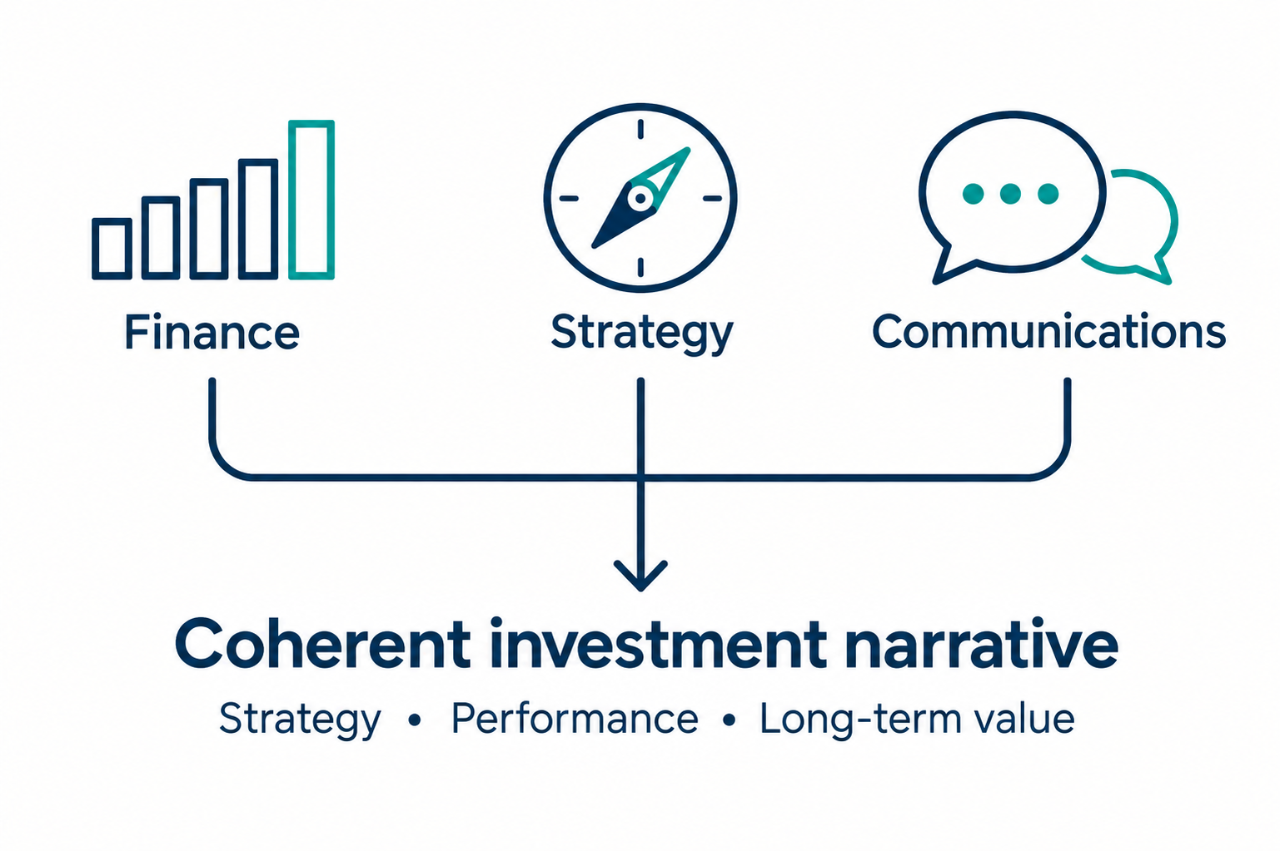
Finance provides the evidence behind performance. Strategy explains the decisions and assumptions. Communications make that account understandable to someone outside the business.
The explanation becomes stronger when teams agree on the main messages before drafting begins.
Finance provides the evidence behind performance. Strategy explains the decisions and assumptions. Communications make that account understandable to someone outside the business.
For example, if international expansion is a priority, the report should explain the investment involved, the reasons for choosing those markets, and how management will judge success. Readers should be able to trace that priority through the operational review and financial discussion, with the relevant risks clearly explained.
That connection matters because readers use different parts of the report to test what management says. A commitment to disciplined growth is easier to assess when capital allocation decisions and performance measures support it. If those connections are missing, readers are left to decide for themselves whether the stated strategy reflects how the business is actually managed.
Before drafting, teams should agree on:
This also helps prevent the report from becoming a collection of departmental updates, each accurate on its own but difficult to read as a consistent account of the company.
Our research found that 93% of STI30 companies acknowledge underperformance, setbacks, or challenges.
That is an encouraging sign of balanced reporting. But acknowledging a problem gives readers only part of the information they need.
A decline in profitability, for example, could reflect temporary disruption, a deliberate investment decision, or a more persistent weakness in the business. Those explanations have different implications for future performance. Readers need enough detail to distinguish between them.
A useful discussion should explain:
This gives investors a basis for assessing management’s judgement and accountability. It also helps employees and business partners understand how the company responds when plans do not work out.
The following year’s report should return to the issue. If a company describes corrective action but never reports on its outcome, readers cannot judge its effectiveness. Consistent follow-up allows confidence to develop through evidence over time.
Only 17% of STI30 companies in our research provide sensitivity analysis of financial outcomes.
This matters because an outlook depends on assumptions. Demand, borrowing costs, exchange rates, or input prices can affect whether a business achieves its plans. Sensitivity analysis helps readers understand the resilience of the business and its ability to navigate changing conditions.
Consider a company investing in additional capacity. Its outlook becomes more useful when readers can understand how lower-than-expected demand might affect utilisation and profitability. They can then assess the exposure alongside management’s plans to respond.
The 17% finding concerns one specific reporting practice. It does not mean that the remaining companies provide no useful outlook information. It does, however, point to an opportunity to explain the relationship between assumptions and outcomes more clearly.
Depending on the business, that could include:
The aim is to help readers understand the basis for management’s expectations and the limits around them. A considered explanation of uncertainty can make an outlook more credible, because readers can see how the company has assessed its exposure.
Taken together, these findings suggest a useful test for the next reporting cycle: does the report give readers enough information to assess the business for themselves?
Last year’s structure may still work, but familiar sections can conceal gaps. Internal teams already understand how the company operates. They may not notice where a new reader needs an explanation or where the connection between two disclosures is unclear.
At Black Sun, we combine technical reporting advice with narrative development and design to address these questions. Our research across Singapore, Hong Kong, and the UK informs that work, helping clients compare their approach with local peers and international companies competing for capital.
Benchmarking is most useful when it leads to specific improvements: a clearer explanation of the business model, a closer connection between strategy and performance, or a more informative discussion of the outlook.
Those improvements can support communications throughout the year. The account developed for the annual report can inform investor presentations, leadership communications, and the corporate website, giving audiences a consistent explanation of the company.
Your next report will help shape how people judge your business. Make it easy for them to understand the decisions behind the results, assess progress, and form a considered view of what comes next.
To discuss how Black Sun can support your next reporting cycle and explore how your reporting compares against the STI30 findings, please get in touch with Beryl Leong at bleong@blacksun-global.com
About Black Sun
Black Sun Global is a stakeholder advisory and engagement agency that's been driving transformation and positive change for ambitious brands for more than 20 years. With deep expertise in disclosure and reporting, ESG, sustainability, and digital engagement, we reshape how organisations connect with customers, investors, employees, and the wider world.
We are trusted partners to some of the most influential global organisations, sparking innovation and sustainable performance through our strategic insights, partnerships, and proprietary technologies.
As founders of the Positive Change Group, we are on a mission to create a new kind of stakeholder relations partner. Our world-class specialists work closely with executive leadership teams to protect reputations, inspire trust, and promote responsible business practices - building resilience and long-term value in a rapidly changing world.
For more information, please visit: www.blacksun-global.com
Explore our thinking and learn from global thought leaders through
our blogs, podcasts, webinars, and events.